Table of Contents
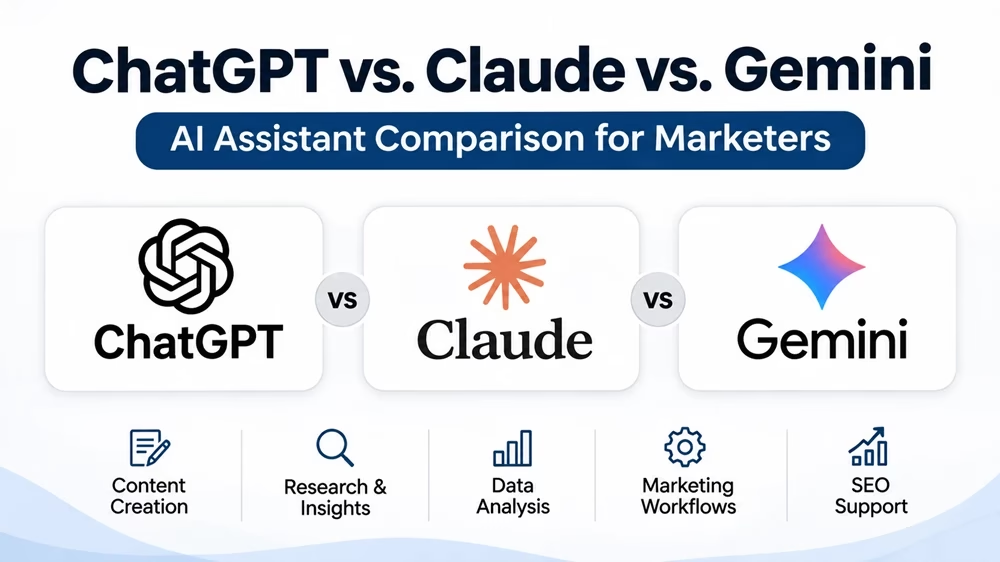
The Multi-Model Marketing Stack
| AI Assistant | Best For | Key Strengths |
|---|---|---|
| Google Gemini | Research and Google Workspace | Google Search-based research, document analysis, and Workspace integration. |
| Anthropic Claude | Long-form writing and document analysis | Detailed instruction following, writing, and handling lengthy documents. |
| OpenAI ChatGPT | Marketing content, creative production, and data analysis | Content generation, data analysis, image generation, and connected tools. |
1. Core Comparison Matrix: AI Assistants by Marketing Task
| Marketing Workflow | Recommended Starting Point | Alternative | What Makes It Useful |
|---|---|---|---|
| Long-Form Articles and Case Studies | Claude | ChatGPT | Detailed instructions, document context, and writing refinement. |
| Real-Time Market Research | Gemini | ChatGPT | Google Search-based research and source discovery. |
| Ad Copy and Creative Variations | ChatGPT | Claude | Brainstorming, content variations, and creative development. |
| SEO Content Briefs | ChatGPT | Gemini / Claude | Content planning, search intent analysis, and topic organization. |
| Schema Markup (JSON-LD) | ChatGPT | Claude | Generating and reviewing structured data. |
| Google Workspace Workflows | Gemini | ChatGPT | Integration with Google productivity applications. |
| Data Analysis and CSV Audits | ChatGPT | Gemini / Claude | File analysis, calculations, and data interpretation. |
| Social Media Content | ChatGPT | Claude | Generating and adapting platform-specific content. |
| Long Documents and Research Reports | Claude | ChatGPT / Gemini | Working with extensive reference material and detailed instructions. |
Remember: The actual quality and performance of an assistant depends on the model’s version, prompt quality, featured tools, integrations, and subscription plan.
2. Deep Analysis: Evaluating Each Assistant on Core Marketing Workflows
A. Long-Form Writing and Brand Voice Alignment
Recommended Starting Point: Claude (Anthropic)
Claude is a strong option for producing detailed blog posts, customer case studies, whitepapers, and newsletters. Marketers use it for consistent brand messaging, logical organization, natural language, and the ability to follow detailed editorial instructions.
It can work with long documents, follow detailed writing instructions, and help maintain a consistent tone across different content formats. [Claude’s web search and web page retrieval capabilities]
However, ChatGPT and Gemini can also produce high-quality long-form content when provided with suitable reference material and clear instructions.
Claude is best used for:
- Long-form SEO articles.
- Brand messaging guidelines.
- Whitepapers and case studies.
- Email newsletters.
- Thought-leadership articles.
- Content editing and refinement.
How to check its usefulness:
Provide Claude with your brand guidelines, three previously published articles, and a new article brief. Ask it to produce a draft that follows your established writing style.
Then, check how well it maintains your brand voice, avoids repetition, follows your instructions, and incorporates the information provided to it.
Now, do the same with Gemini or ChatGPT. Evaluate which output is the best for you.
My Experience:
B. Live Market Research, SERP Trends, and Competitor Insights
Recommended Starting Point: Gemini (Google)
ChatGPT and Claude also have the capabilities of web search and research capabilities.
Remember: AI-generated research is not a substitute for dedicated SEO tools. They can provide more details on keyword search volume, keyword difficulty, actual Google rankings, and historical SERP data.
Gemini is best used for:
- Market research.
- Competitor positioning analysis.
- Industry trend identification.
- Research for content marketing campaigns.
- Finding supporting sources and statistics.
- Understanding changing customer needs.
My Experience:
Gemini provides better results for marketing research, SERP trends, and competitor insights. However, ChatGPT is also a capable tool for the job.
C. Performance Marketing, Social Copy, and Creative Testing
Recommended Starting Point: ChatGPT (OpenAI)
Its capabilities can help marketers transform a product description into multiple advertising concepts and adapt messages for different platforms. For example, ChatGPT can transform a single product announcement into:
- Facebook advertising headlines.
- Instagram captions.
- LinkedIn promotional posts.
- YouTube video scripts.
- Landing page headlines.
- Email marketing copy.
Besides, ChatGPT can suggest visual ideas and generate marketing graphics. Claude and Gemini can perform many of these tasks as well.
ChatGPT is best used for:
- Social media content calendars.
- Paid advertising copy variations.
- Landing page headlines.
- Promotional email campaigns.
- Creative brainstorming.
- Content repurposing.
- Marketing campaign concepts.
My Experience:
D. SEO Content Creation and Optimization
Recommended Starting Point: ChatGPT or Gemini
SEO professionals can use all three assistants throughout the content optimization process. Besides writing articles, they are useful for content planning, search intent analysis, topic organization, structured data generation, and content improvement.
For example, you can provide a target keyword, competitor URLs, and an existing article to ChatGPT or Gemini. It can then help identify missing subtopics, improve the article structure, and suggest additional information for readers.
They are best used for:
- SEO content briefs.
- Search intent classification.
- Content gap analysis.
- On-page optimization.
- Schema markup generation.
- Internal linking suggestions.
- Answer Engine Optimization (AEO).
My Experience:
I tried the three AI tools using the same keyword and competitor URLs. In my case, ChatGPT can identify the most useful content gaps and produces the most actionable SEO recommendations.
E. Google Workspace and Marketing Operations
Recommended Starting Point: Gemini
Google Workspace integration is an important consideration for marketing professionals if they regularly work with Gmail, Google Docs, Google Sheets, and Google Drive.
Gemini can assist with several productivity activities, depending on the available application integrations and subscription. ChatGPT and Claude also support various integrations and connected workflows.
However, if you use most of the Google products, Gemini is the best option.
Gemini is best used for:
- Marketing documentation.
- Spreadsheet-related tasks.
- Email productivity.
- Campaign reporting.
- Research organization.
- Collaborative workflows.
3. Marketing Performance Reporting
Marketing professionals frequently work with spreadsheets, CSV exports, and performance reports.
ChatGPT has data analysis capabilities, including calculations, Python-based analysis, and chart generation. Claude and Gemini also provide data analysis capabilities, with available tools and model access.
You can upload campaign performance data and ask an AI assistant to:
Identify the best-performing campaigns.
Calculate conversion rates and cost per conversion.
Compare campaign performance.
Identify underperforming advertising channels.
Detect trends and unusual changes.
Generate charts and visual summaries.
Recommend areas for further investigation.
For example, upload a Google Search Console CSV export for your website that includes clicks, impressions, CTR, and average position.
Ask to identify:
Pages receiving high impressions but low CTR.
Keywords with significant impressions but relatively low average positions.
Pages experiencing declining clicks.
Opportunities for improving existing content.
Remember that the calculations and interpretations it produces should be checked against the original data before making a final decision.
My Experience:
Free and Paid Plan
Pricing is an important consideration for freelancers, bloggers, small businesses, and marketing agencies. ChatGPT, Claude, and Gemini all provide free and subscription plans. However, their features, usage limits, model availability, and pricing structures are different.
Subscription Pricing: For most individual users, the entry paid tiers of ChatGPT Plus ($20), Claude Pro ($20), and Gemini Advanced ($19.99) are priced almost identically in the U.S. Their higher tiers cost more.
You can check the official websites for their current subscription tiers and pricing:
ChatGPT: https://chatgpt.com/
Claude: https://claude.com/
Google Gemini: https://gemini.google.com/
Which Plan Should Marketers Choose?
Small, individual marketers and freelancers may find free plans sufficient for occasional content creation, research, and brainstorming. Only marketing professionals and agencies who regularly analyze large files, conduct research, or produce marketing content can upgrade to a subscription plan.
Workflow Decision Framework: How to Build Your Marketing Stack
A single AI can perform most of the tasks you need. However, if you want quality output from every task, you can use an AI tool stack rather than being forced to use a single platform for your workflow.
Recommended Workflow 1: Content Strategists and SEO Copywriters
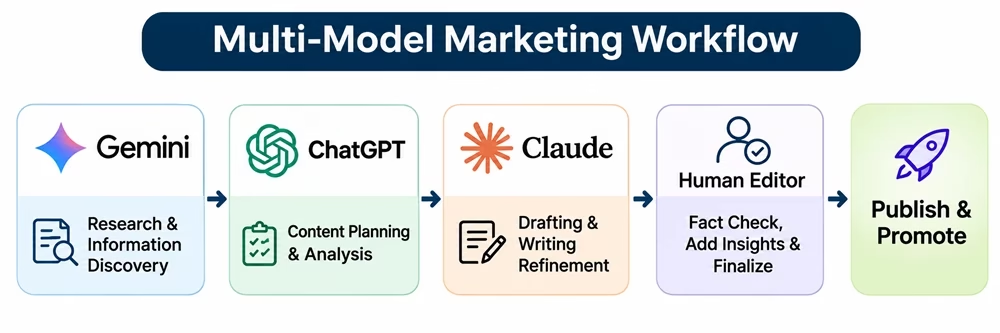
Gemini (Research and Source Discovery) → ChatGPT (Content Planning and Analysis) → Claude (Drafting and Writing Refinement) → Human Editing
Use Gemini to research current information, then ChatGPT to develop the content structure and supporting ideas, and Claude to prepare or refine the article. After the final draft is generated, you should verify facts, add your own original insights for the target audience, and ensure that the final article meets editorial requirements.
Recommended Workflow 2: Paid Media and Performance Marketers
Gemini (Market and Competitor Research) → ChatGPT (Advertising Concepts and Variations) → Human Review → A/B Testing
Research competitors’ positioning using Gemini, generate advertising variations using ChatGPT, then review and edit the messaging and test different versions across your advertising platforms.
Recommended Workflow 3: Operations and Analytics Teams
ChatGPT (Data Analysis and Reporting) → Gemini (Google Workspace Workflows) → Human Review
Use ChatGPT to analyze your campaign data and generate the reports, then use appropriate Google Workspace tools to organize and share the results.
Recommended Workflow 4: Social Media Managers
ChatGPT (Content Ideas and Platform-Specific Copy) → Claude (Content Refinement) → Human Review → Publishing
Generate content ideas and adapt messages for different platforms using ChatGPT, then use Claude to refine the tone before scheduling and publishing on social media platforms.
Important: You don’t necessarily need a large budget to pay for three subscriptions for your workflows. If you are a small team or a freelancer, you can start with one primary assistant and use free alternatives when necessary.
Practical Tests: How to Compare ChatGPT, Claude & Gemini
You can check which AI assistant performs best for your marketing requirements. Here are five tests to compare them practically using identical prompts and materials.
Test 1: For an SEO Content Brief
Ask ChatGPT, Gemini, and Claude one by one to prepare an SEO content brief for the keyword: “Best Email Marketing Tools for Small Businesses.“
Then, evaluate and compare each result for:
- Search intent identification.
- Suggested article structure.
- Topic coverage.
- Content recommendations.
- Practical usefulness.
Test 2: Long-Form Article Writing
Ask the three AIs, providing your brand guidelines, to write a 1,000-word article.
Then, compare each article for:
- Readability.
- Factual accuracy.
- Brand voice consistency.
- Repetition.
- Editing requirements.
Test 3: Advertising Copy Generation
Provide the same product description to the three and ask them to generate 10 Facebook advertising headlines and descriptions.
Then, compare their results for:
- Creativity.
- Audience targeting.
- Persuasiveness.
- Variation quality.
- Platform suitability.
Test 4: Marketing Data Analysis
Upload the same campaign performance CSV file to all three assistants. Then ask them to identify the best-performing campaigns, calculate important metrics, and recommend improvements.
Then, compare the numerical accuracy, interpretation, and presentation generated by each assistant.
Test 5: Competitor Research
Find any three of your competitor websites and ask each assistant to analyze them.
Then, compare each report generated by them in:
- Research depth.
- Source quality.
- Accuracy.
- Identification of content gaps.
- Actionable recommendations.
After evaluating the results of these tests, you can determine which AI assistant works better for a specific task.
Limitations and Risks of Using AI Assistants for Marketing
Although any AI assistants you use can improve marketing productivity, they are not without limitations. When marketers use them, they usually face the following issues in AI-generated outputs.
1. Inaccurate Information: They may generate incorrect statistics, references, and product information. You have to verify important claims by checking with reliable sources.
2. Generic Content: Articles written by them may contain repetitive explanations from sources, predictable headings, and generic recommendations. It is important to add your original insights and practical experience to make the article unique.
3. SEO Limitations: Keyword suggestions generated by them should not be final for your use. Make sure you use a popular SEO tool for actual keyword research, search volume data, or ranking analysis.
4. Data Privacy: Consider privacy risks before uploading confidential client information, customer records, or sensitive campaign documents to an AI assistant.
5. Human Editorial Oversight: Always review and edit AI-generated content for accuracy, originality, relevance, and usefulness before publication.
Marketers can use AI to support their workflow, but remember that it cannot replace a human professional in judgment and strategic decision-making.
Which AI Assistant Should Marketers Choose?
There is no universally best AI assistant for every digital marketing activity. The right choice depends on your objectives, budget, working areas, and requirements.
Here are general recommendations on which AI is better for which marketer:
| Type of Marketer | Recommended AI | Reason |
|---|---|---|
| SEO Specialists | ChatGPT or Gemini | Content planning, research, and data analysis. |
| Content Writers | Claude or ChatGPT | Long-form writing and content refinement. |
| Social Media Managers | ChatGPT | Creative ideation and content variations. |
| PPC Specialists | ChatGPT | Advertising copy and campaign data analysis. |
| Market Researchers | Gemini or ChatGPT | Web research and information synthesis. |
| Google Workspace Users | Gemini | Google productivity ecosystem integration. |
| Digital Marketing Agencies | Combination of all three | Different tools for different workflows. |
| Freelance Marketers | One primary assistant | Lower costs and simpler workflows. |
These recommendations are starting points, not definitive rankings. On the other hand, AI models continue to improve. So, test any model against your actual requirements before making a purchasing decision.
In Summary
Stop thinking that a single AI assistant can handle every marketing task. ChatGPT, Claude, and Gemini are useful tools for modern digital marketers. Before making your decision, run several tests to see which AI assistant produces accurate, useful results for your specific marketing activities.
Compare their outputs, verify their capabilities, and build a workflow that saves time without compromising content quality in your field. Choose one that can produce high-quality outputs that meet your expectations and require less review and editing.
My suggestion is: start using any of them with the free version. They are generally enough for occasional use. When you have to use them heavily, consider buying a subscription.
Gemini, ChatGPT, and Claude are popular AI tools for a variety of uses. If you subscribe to their premium model, you have to pay a monthly fee.
If you are looking for an AI tool for some specific purposes, there are many alternatives you can buy for a low one-time payment. → Check out AppSumo Lifetime Deals
For further reading:
Disclosure: We are partners or associates of Amazon and other top brands. We may earn a small amount from qualifying purchases without increasing the price. Please read our full affiliate disclosure here.

Related posts:
- Beyond ChatGPT: 4 AI Tools for Research, Writing, SEO, and Design
- 48+ Free Google Gemini Prompts for Content Writers
- 10 ChatGPT Use Cases in Digital Marketing (50+ Prompts)
- How to Repurpose One Blog Post into 5 Types of Content Using AI
- GEO (Generative Engine Optimization): How to Optimize Your Content to Be Cited by AI Search
