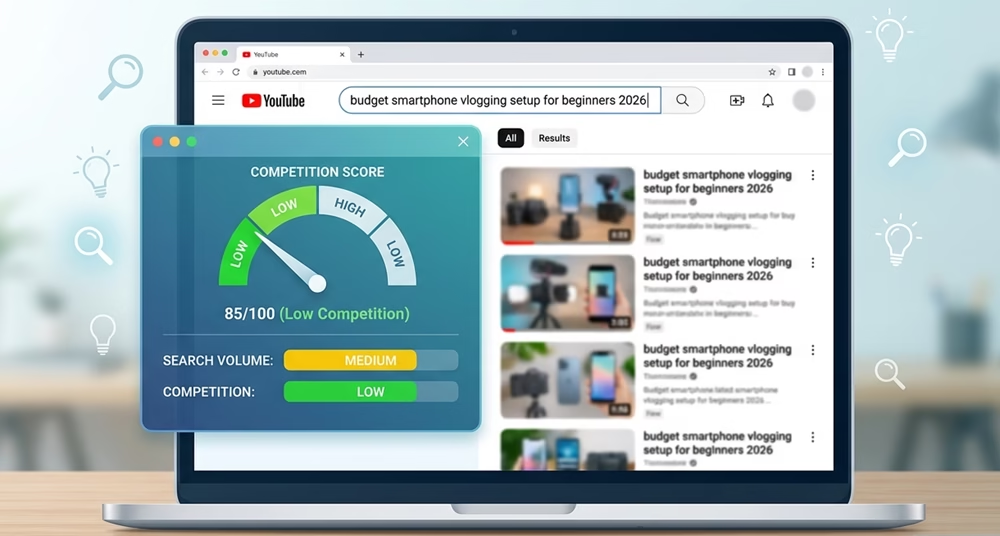
Finding low-competition YouTube topics is one of the fastest ways to grow a channel, especially if you are not starting with a huge audience. Instead of trying to fight for impossible keywords, you focus on topics that people are already searching for but that fewer creators are making videos about. That gives your content a much better chance of ranking in YouTube search, getting suggested, and attracting the right viewers.
The goal is not just to find “easy” topics. The goal is to find topics with real demand, low competition, and strong viewer intent. In this guide, you will learn a practical process for finding those topics and turning them into videos that can rank.
Why low-competition topics matter
Most new creators make one of two mistakes. They either choose topics that are too broad, like “YouTube growth,” or they chase extremely competitive keywords, where large channels already dominate. In both cases, the chance of ranking is low.
Low-competition topics help you:
- get more visibility faster
- rank with a smaller channel
- build topical authority step by step
- attract viewers who are actively looking for help
- create a stronger content plan for the future
When you consistently publish around low-competition topics, YouTube starts understanding what your channel is about, and your videos become easier to recommend.
Table of Contents
Step 1: Start with a small niche
The easiest way to find low-competition topics is to narrow your niche first. A broad niche gives you too many possible directions, which makes keyword research harder. A focused niche gives you clearer topic ideas and better ranking chances.
Instead of:
- YouTube
- Marketing
- Tech
- Fitness
Try:
- YouTube growth for small creators
- SEO tools for beginners
- Budget smartphone tips
- Home workouts for beginners
- Spoken English for students
A smaller niche does not limit you. It actually helps you find more searchable ideas because you can go deeper into one audience’s problems.
Step 2: How do I use YouTube search suggestions for keyword research?
YouTube search itself is one of the best free keyword tools. I start typing a broad keyword into the YouTube search bar and look at the autocomplete suggestions. These suggestions are based on real searches, which means they reflect what users actually want.
For example, if I type something like:
- YouTube SEO
- YouTube growth
- YouTube tools
- YouTube subscribers
I get suggestions like:
- YouTube SEO for beginners
- YouTube growth tips 2026
- best free tools for YouTube growth
- how to get first 1000 subscribers
These are often excellent topic ideas because they show specific intent. The more specific the phrase, the easier it can be to rank.
Step 3: Look for questions, not just keywords
Why? Because low-competition topics are often hidden inside questions. Viewers frequently search with “how,” “what,” “why,” “best,” “easy,” and “for beginners.”
Examples:
- How to rank YouTube videos faster
- What is the best free thumbnail tool?
- Why is my YouTube channel not growing?
- How to get YouTube subscribers without ads?
- What are the easiest YouTube topics for beginners?
Questions are powerful because they show a clear problem. When a viewer has a problem, they are more likely to click, watch, and engage. That helps your video perform better.
You can find these questions in:
- YouTube autocomplete
- comments on competitor videos
- Reddit and Quora
- Google “People also ask”
- video titles from similar creators
Keyword research becomes more powerful when combined with SEO. Learn more in our YouTube SEO guide.
Step 4: Why I study smaller channels in my niche
One of the smartest ways to find low-competition topics is to study channels that are similar to yours in size. Do not only study big creators. Big channels often make it look easy because they already have authority.
Look at smaller channels and ask:
- Which videos got more views than usual?
- What titles are they repeating?
- Which questions keep appearing in comments?
- What kind of videos are they making that still have low production quality but high views?
If a smaller channel with 500 or 1,000 subscribers gets a video with much higher views than its usual average, that topic is probably worth studying. It often means the topic has demand but not too much competition.
Step 5: Check Google Trends for interest
Even though your main platform is YouTube, Google Trends can still help you understand if a topic is rising, stable, or fading. A topic with low competition is useful only if people actually want it.
Search your idea in Google Trends and compare it with other similar topics. You do not need a perfect trending spike. In many cases, a steady or slowly growing interest is enough.
A strong topic usually has:
- consistent interest over time
- occasional seasonal spikes
- clear search intent
- enough related subtopics for future videos
That combination gives you both immediate opportunity and long-term value.
Step 6: Use keyword tools wisely
Free and paid keyword tools can help you validate your ideas. Tools like TubeBuddy, VidIQ, and keyword research platforms can show search volume, competition scores, and related terms.

But do not rely on one score alone. A keyword with low competition may still be useless if nobody cares about it. A keyword with high volume may still be too competitive for a small channel.
Use tools to answer three questions:
- Is there search demand?
- Is the competition manageable?
- Can I make a better video than what already exists?
If the answer to all three is yes, the topic is worth considering.
Note: Other AI tools you can try in 2026 are Ask Studio AI and OutlierKit.
These tools are explained in detail in our guide on best free tools for YouTube growth.
Step 7: Find “content gaps”
A content gap is a topic people are searching for that existing videos do not fully answer. This is one of the best ways to find low-competition ideas.
For example, maybe there are videos about:
- YouTube SEO
- YouTube growth
- keyword research
But very few videos about:
- YouTube SEO for faceless channels
- YouTube growth for absolute beginners
- how to find low-competition YouTube topics
- free tools for YouTube research
Those more specific topics are content gaps. They are easier to rank for because the supply is lower, while the demand may still be strong.
Step 8: Use the competition test
Before choosing a topic, search it on YouTube and look at the results. Ask yourself:
- Are the top results from huge channels only?
- Are the titles too broad?
- Are the thumbnails outdated?
- Are the videos low quality or poorly structured?
- Do the top videos actually solve the viewer’s problem fully?
If the top results are weak, that is a good sign. It means you may be able to make a better, more useful video and take that space.
A topic is often worth targeting when:
- the search results are not saturated
- the videos do not directly answer the query well
- the topic has clear viewer intent
- the keyword matches a specific need
Step 9: Turn one topic into a cluster
Once you find one low-competition topic, do not stop there. Turn it into a cluster. This helps you build topical authority and makes future ranking easier.
Example cluster around YouTube growth (if it is your topic):
- How to Find Low-Competition YouTube Topics
- How to Grow a YouTube Channel in 2026
- How to Get Your First 1,000 Subscribers Fast
- Best Free Tools for YouTube Growth
- YouTube SEO Guide: How to Rank Videos on Page 1 in 2026
When you build a cluster, each video supports the others. That is better for both YouTube and Google.
Once you find the right topics, use them to grow your audience with our
guide to getting your first 1,000 subscribers.
Step 10: Make sure the topic has monetization value
Not every easy keyword is worth chasing. Some topics may be low competition but have very little audience value or monetization potential.
The best topics are:
- useful
- searchable
- relevant to your niche
- strong for watch time
- connected to your products, services, affiliate links, or future content
For example, “how to find low-competition YouTube topics” can support other high-value content like YouTube SEO, YouTube growth, content planning, and tool recommendations. That makes it much more valuable than a random low-competition keyword with no clear path forward.
Simple formula to find topic ideas fast
Use this formula that covers: Audience problem + specific format + clear benefit
Examples:
- YouTube growth tips for beginners
- Best free tools for YouTube SEO
- How to get 1,000 subscribers fast
- YouTube topics for faceless channels
- Easy YouTube content ideas for new creators
This formula helps you stay focused on search intent while still finding less competitive ideas.
Common mistakes to avoid
Many creators fail at topic research because they:
- choose topics only based on intuition
- target huge keywords too early
- ignore search intent
- copy competitor titles exactly
- make videos without checking demand
- focus only on volume and ignore competition
The best approach is balanced. You want enough demand, but not so much competition that your video disappears.
Final thoughts
Finding low-competition YouTube topics is not about luck. It is about learning how people search, watching what your competitors are missing, and choosing ideas that fit your channel’s size and niche.
If you repeat this process, you will get better at spotting opportunities before other creators do. That means faster growth, stronger search traffic, and a channel built on topics you can actually rank for.
Start small, stay specific, and build your content around real viewer problems. That is how low-competition topics turn into real YouTube growth.
Frequently Asked Questions (FAQs)
What are low-competition YouTube topics?
Low-competition YouTube topics are search terms or content ideas that have real viewer demand but fewer strong videos competing for them.
How do I know if a YouTube topic is too competitive?
If the top results are dominated by large channels and the videos already answer the topic very well, the keyword may be too competitive for a small channel.
Are low-competition topics better than trending topics?
Usually, yes, for small creators. Trending topics can bring fast views, but low-competition topics are often easier to rank for and can bring consistent traffic over time.
How many topics should I research before making a video?
Research at least 5 to 10 topic ideas so you can compare demand, competition, and search intent before choosing the best one.
Case Study: Growing a Niche Educational Channel Using Low-Competition Keywords
Channel: 99learners based on English language learning.
The Challenge: The primary obstacle was “Keyword Over-Saturation.” The channel is needed to find “gaps” in the industry.
The Keyword Research Strategy:
Niche Narrowing: Instead of targeting “English Grammar,” our strategy was to find long tail queries to reduce the potential audience size, but significantly lower the competition.
The “Autocomplete” Deep Dive: Using ChatGPT, we first discover English learning topics. I type a topic keyword on YouTube to see the autocomplete and the search results.
- The Opportunity: From the results of a keyword search, I look for any gaps to create content.
- The “Filter” Test: Before creating, I search for phrases aiming to create content for its SEO metrics using a tool like KeywordToolDominator.
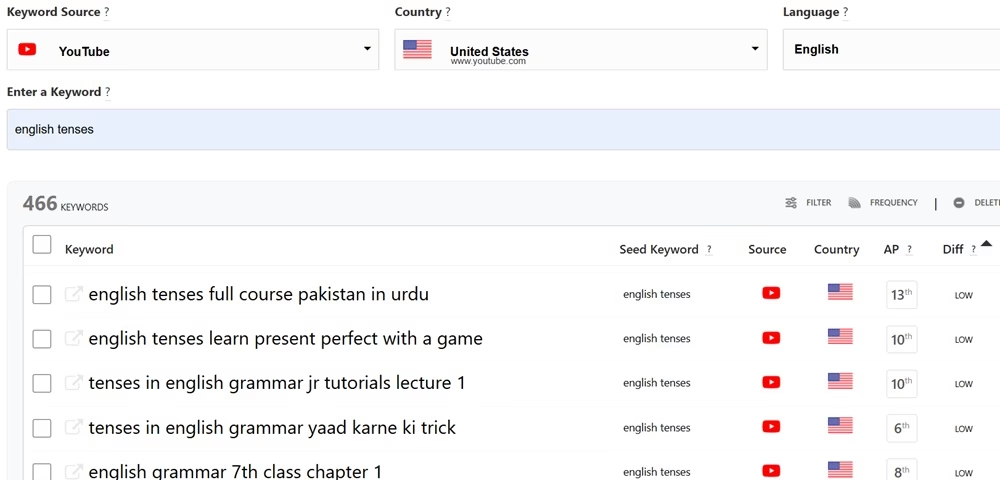
Key Takeaway: Success on YouTube is about being the “first” or “most specific” for a low-competition topic. By shifting focus from high-volume keywords to high-intent long-tail keywords, the new, small channel could bypass established competitors and build a loyal audience from scratch.

Disclosure: We are partners or associates of Amazon and other top brands. We may earn a small amount from qualifying purchases without increasing the price. Please read our full affiliate disclosure here.

Related posts:
- YouTube SEO Guide: How to Rank Videos on Page 1 in 2026
- How to Grow a YouTube Channel in 2026: Complete Beginner to Advanced Guide
- How to Start a YouTube Channel in 2026 (Step-by-Step)
- YouTube Channel Growth Blueprint for Small Creators for 2026
- 10 Mistakes That Kill YouTube Growth (And How to Fix Them)